
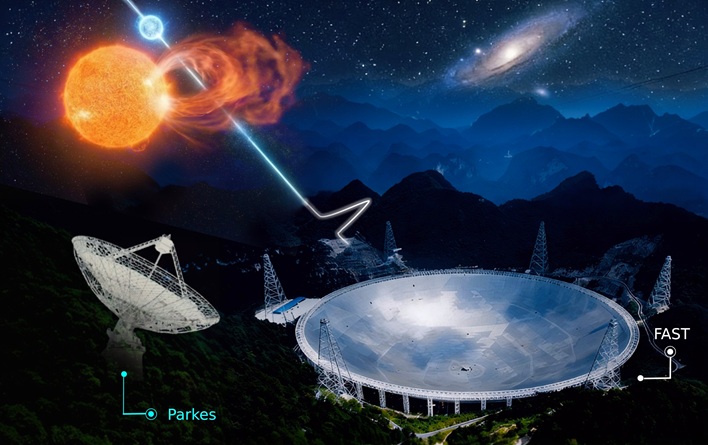
Fast Radio Bursts (FRBs) have puzzled astronomers since their discovery in 2007. These millisecond-long flashes of radio waves arrive from distant galaxies, carrying in a single burst more energy than our Sun emits in an entire day. Some FRBs flash once and are never seen again. Others repeat, offering rare opportunities to study their origins. The question has always been: what kind of cosmic object produces such extraordinary signals?
Now, after nearly two years of observations of one FRB source with the Five-hundred-meter Aperture Spherical Radio Telescope (FAST) in China—the world's largest and most sensitive radio dish and also called "China's Sky Eye"—an international team of 38 co-authors from 35 institutions including Bing Zhang, Chair Professor of Astrophysics of The University of Hong Kong, has found a crucial clue. In a paper published in Science in January 2026, in which Zhang is a corresponding author, the team claimed that they have found a definite clue that the FRB resides in a binary star system, with the source of the FRB likely an extremely magnetised neutron star locked in orbit with a companion star. The evidence came in the form of a sudden and dramatic change in the burst's magnetic environment, a phenomenon the team has named an "RM flare."
Reading the Magnetic Fingerprints
Radio waves, like visible light our eyes see, are electromagnetic waves characterised by oscillations of electric and magnetic fields. The direction of electric fields in the plane perpendicular to the line of sight determines the direction of polarisation. Whereas most astronomical objects (like stars) emit light with random oscillation directions so that net polarisation is nearly zero, FRBs are known to emit radio waves with significant (sometimes nearly 100%) polarisation. When the polarised radio waves travel through space, they carry information about the environments they pass through. In particular, if these waves encounter a magnetised region filled with charged particles (a plasma), their vibration direction gets twisted. The degree of twisting depends on the wavelength, an effect known as "Faraday rotation".
Astronomers measure this twisting effect using the Rotation Measure (RM), which can be thought of as a magnetic fingerprint. A high RM indicates that the waves have travelled through dense, strongly magnetised plasma, while a low RM suggests a cleaner path. By tracking how RM changes over time, we can effectively "see" changes in the environment surrounding the FRB source, even from billions of light-years away.
A Sudden Spike and Gradual Recovery
The source of interest, FRB 20220529, was first detected to be repeating in May 2022 with the Canadian radio telescope known as CHIME. This made it an ideal target for the FAST FRB Key Science Project, co-led by Zhang and the FAST Principal Investigator Dr Wei-Wei Zhu. Under the leadership of Drs Ye Li and Xuefeng Wu from Purple Mountain Observatory, the team started long-term monitoring of the source. For the first 17 months, it behaved quietly. Its RM fluctuated modestly between -300 and +300 radians per square meter, with an average near zero. The source was active but unremarkable—until December 2023.
On 14 December, the team detected one burst with an RM value of nearly +2000 rad/m²—an increase of more than twentyfold. It was as if a dense, magnetised cloud had suddenly drifted into our line of sight. What followed was even more revealing. Over the next two weeks, the RM declined steadily, returning to its normal level by 28 December. During this period, the bursts also became less polarised, dropping from their usual 80% linear polarisation to just 27%, before recovering alongside the RM.
This transient event, which the team calls an "RM flare", told us something profound —a clump of magnetised plasma had briefly crossed our line of sight to the FRB source. The question that remained was its origin.
Two Suspects, One Culprit
The team considered two main possibilities. The first was the FRB source itself. The leading theory suggests that FRBs come from magnetars—neutron stars with extraordinarily strong magnetic fields, left behind after massive stars explode. Could the magnetar have ejected this plasma in a giant flare? Possibly, but there are several inconsistencies. The required energy would be thousands of times larger than any magnetar flare ever observed in our own galaxy. Moreover, we have never seen such RM changes accompanying bursts from the only Galactic FRB-emitting magnetar we know. Finally, the evolution of RM is not well explained by this model.
The second possibility was more compelling. What if the magnetar has a companion—another star orbiting nearby? Stars like our Sun constantly shed material in stellar winds and occasionally erupt with coronal mass ejections (CMEs), the same dramatic events that can disrupt satellites when they hit Earth. If such a CME from a companion star happened to cross our line of sight, it would create precisely the kind of transient RM signature we observed.
The numbers fit beautifully. From the two-week recovery time, the team estimated the plasma clump's size and the inferred plasma density, all matching known observations of binaries and stellar CMEs perfectly.
Why This Discovery Matters
This finding provides the first concrete evidence that at least some repeating FRBs are in binary systems. It transforms our understanding of these mysterious sources, suggesting that while FRBs originate from dead stars (magnetars), they engage in dynamic interactions with living stellar companions.
It also opens a new window for studying stellar physics across cosmic distances. The CME detected by the team came from a star 2.5 billion light-years away. One cannot see that star directly—it is far too faint—but one can study its eruptions through their imprint on FRB signals.
Finally, it validates theoretical work that suggests binary interactions might explain why some FRBs repeat while others do not. A companion star could provide the right environment to enable repeated bursts, as suggested earlier by Zhang and others.
Looking Forward
The calculations by the team suggest that such RM flares may not be rare. With continued monitoring, one expects to catch more such events, not only from FRB 20220529 but from other repeating sources as well. Each detection will add another piece to the puzzle.
FAST, with its unparalleled sensitivity, is ideally suited for this work. This discovery is a testament to the power of patient, persistent observation. The universe reveals its secrets not in sudden flashes alone, but through careful tracking of change over time. This discovery was made possible by the unique capabilities of FAST, its dedicated FRB Key Science Project, and the tireless efforts of an international team of astronomers. It marks a major step forward in our journey to understand the origins of one of the most mysterious cosmic radio signals, revealing a dynamic and interconnected universe where dead stars and their living companions can together create spectacular fireworks across the cosmos.
Original publication
Y. Li, S. B. Zhang, Y. P. Yang … B. Zhang, A sudden change and recovery in the magnetic environment around a repeating fast radio burst. Science 391, 280-284 (2026). DOI:10.1126/science.adq3225
Author
Prof Bing Zhang, Chair Professor of Astrophysics, Department of Physics, The University of Hong Kong
March 2026