
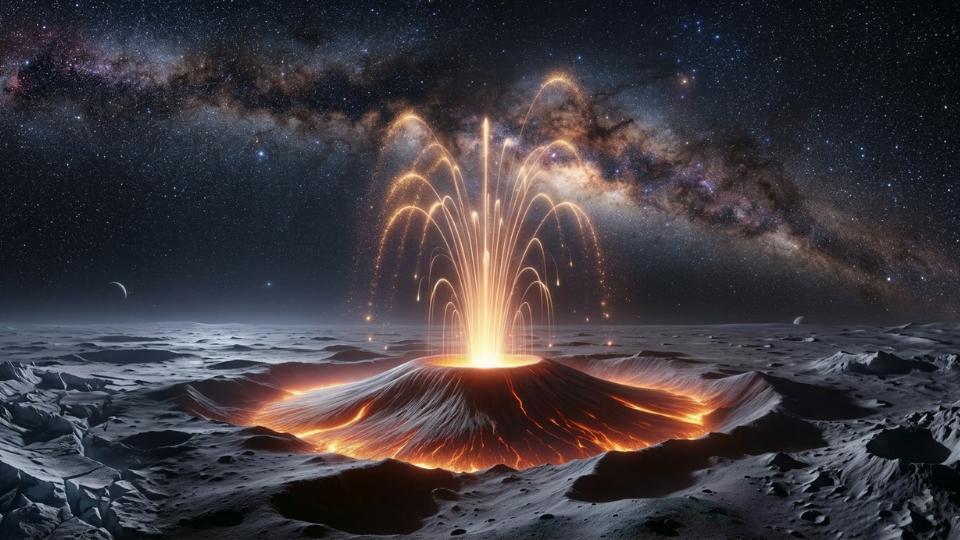
Secrets in the Soil: How Apollo 17 Volcanic Glasses Continued Degassing on the Moon
Introduction: The Rediscovery of a "Wet" Moon
For decades after the Apollo missions, the Moon was widely viewed as a bone-dry world. According to that picture, the giant collision thought to have formed the Moon would have stripped much of its interior of water, sulfur, and other volatile elements.
That view began to change in 2008, when new analyses of Apollo volcanic glass beads revealed water of likely indigenous lunar origin. Later studies suggested that the magmas feeding these pyroclastic eruptions came from volatile-bearing regions within the Moon. In other words, the lunar interior was not uniformly dry after all.
But this discovery raised a major question. If lunar magma contained significant amounts of gas, how did those gases escape during eruption into the vacuum of space?
For years, the standard model assumed a simple two-stage story. First, gases separated from the magma as it rose toward the surface. Then, after the magma fragmented into droplets, the remaining volatile loss was thought to occur during the droplets' short free flight before they landed on the Moon.
In our recent study published in Nature Communications, we tested that long-standing assumption using numerical modelling and data assimilation. Focusing on Apollo 17 sample 74220 — the famous "orange soil" collected near Shorty Crater (Figure 1) — we found that free-flight degassing alone cannot explain the measurements. Instead, our results point to a striking alternative: after the eruption ended, the volcanic glass beads continued cooling and releasing volatiles on the lunar surface for years.
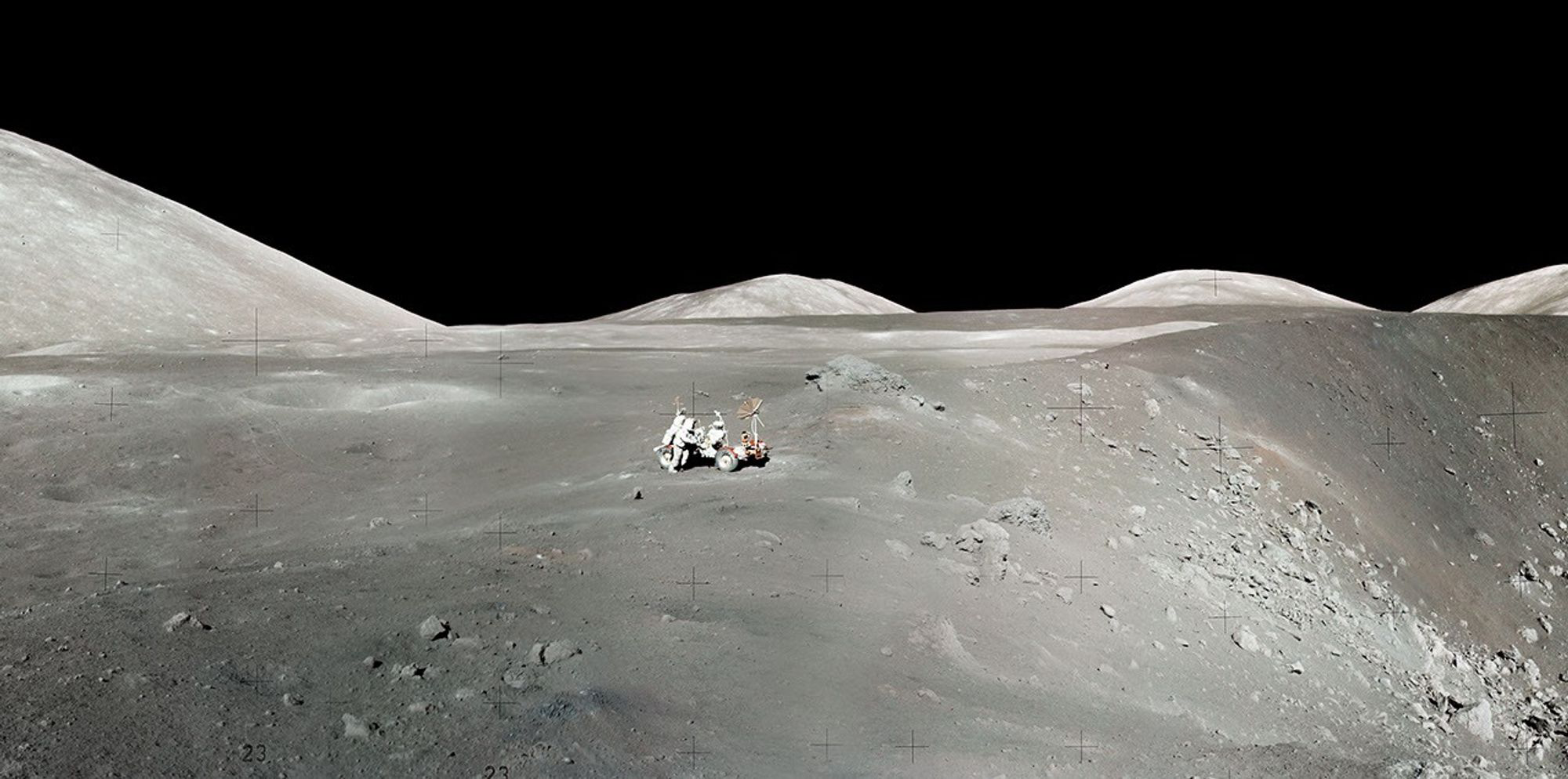
Figure 1. Apollo 17 astronauts Harrison "Jack" Schmitt and Eugene Cernan captured this view of the rim of Shorty Crater
and the lunar roving vehicle, with the Taurus-Littrow massifs rising in the background. The image is from the NASA.
Reading the Eruption Record: Three Lunar Witnesses
To reconstruct a volcanic eruption that happened about 3.5 billion years ago, we turned to the chemical record preserved in Apollo sample 74220 (Figure 2). This remarkable sample contains three kinds of materials (Figure 3), each preserving a different part of the degassing history.
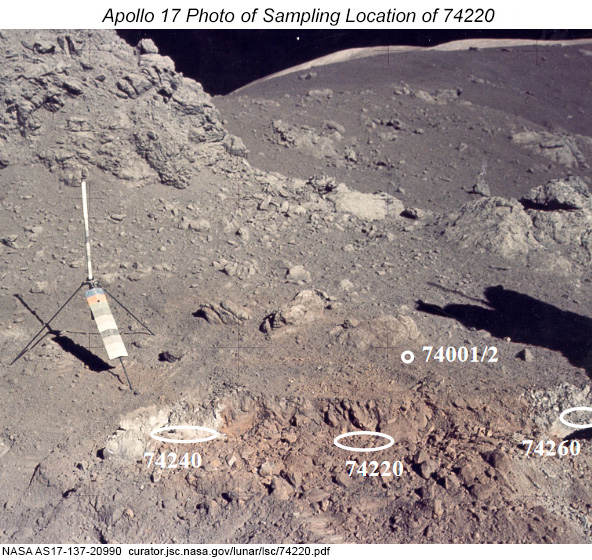
Figure 2. Apollo 17 field photograph of the trench excavated into the orange soil at the rim of Shorty Crater, showing the sampling site of the 74220 orange glass. NASA photo AS17-137-20990.
Olivine-hosted melt inclusions are tiny pockets of magma trapped inside growing olivine crystals before eruption. Because they were sealed within their host crystals, they preserve some of the best evidence of the magma's original volatile content.
Melt embayments are small channels or pockets connected to the edges of olivine crystals. They were only partly protected, so they record an intermediate stage of volatile loss.
Glass beads, or spherules, are droplets of magma that were thrown into the lunar sky, rounded by surface tension, and quenched into glass. Because they were fully exposed, they were the most vulnerable to degassing.
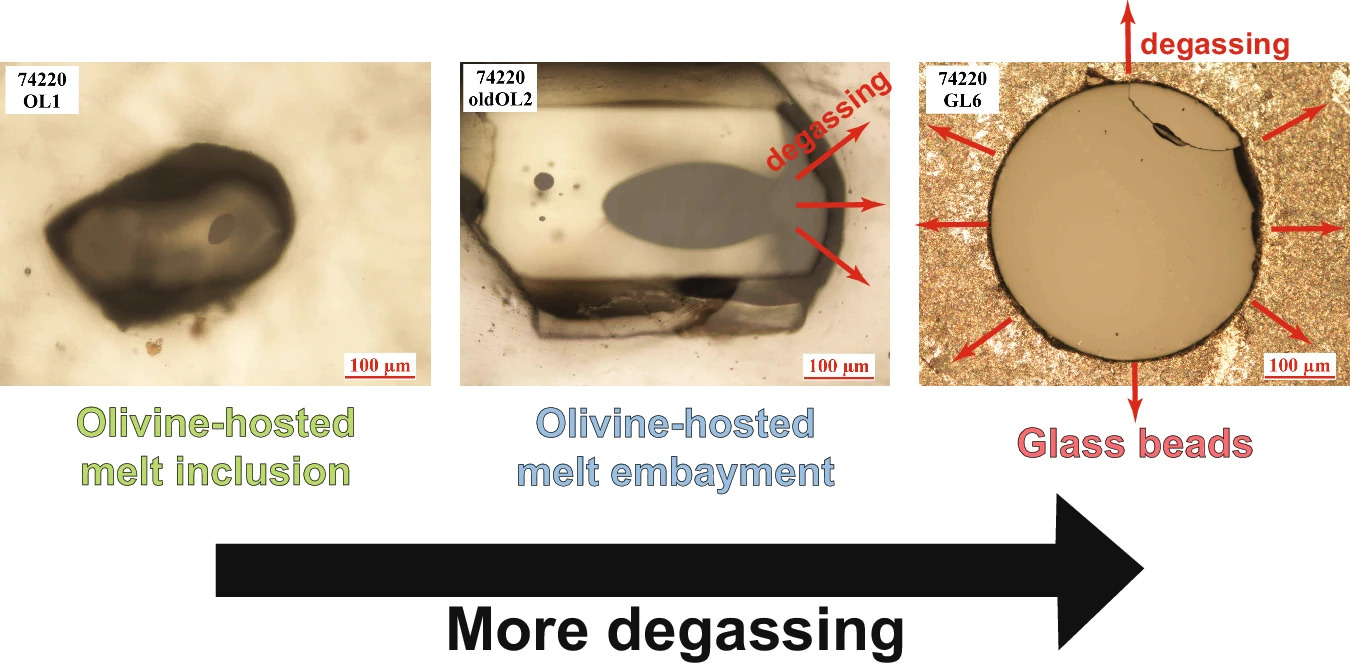
Figure 3. Microscopic views of specimens from Apollo sample 74220 that preserve different degrees of volatile loss. Melt inclusions enclosed within olivine are the most protected and therefore least affected by degassing during eruption. Melt embayments are only partly enclosed and can lose volatiles through their exposed openings, whereas glass beads are fully exposed and thus most susceptible to degassing. The olivine grain in the centre (74220 OldOL2) contains both melt inclusions and a melt embayment. Images are from the paper by Ni and Zhan (2026).
When we compare measurements of water, fluorine, chlorine, and sulfur across these three sample types, a clear pattern appears. The melt inclusions contain the highest volatile concentrations, the melt embayments show intermediate loss, and the glass beads are by far the most depleted.
For water, the contrast is especially dramatic. Some melt inclusions contain up to 1,205 parts per million of H2O, while the exposed glass beads retain only tiny fractions of that amount — roughly 98% to 99.9% less.
Why Free-Flight Alone Cannot Explain the Data
Earlier studies commonly assumed that most volatile loss from lunar glass beads happened during free flight, after eruption and before landing. To test whether that idea works for Apollo 17 orange beads, we built a model of volatile diffusion out of cooling melt droplets.
Because diffusion depends strongly on temperature, we paired the diffusion model with a cooling history starting from the magma's liquidus temperature of about 1,603 K. We tracked the behaviour of water, fluorine, chlorine, and sulfur, using sulfur as an important reference because it diffuses more slowly than the other three.
The results showed a major mismatch between chemistry and physics. To reproduce the severe volatile depletion measured at the centres of the orange beads, the model required cooling timescales of roughly 103 to 104 seconds — that is, thousands to tens of thousands of seconds. For a large melt embayment about 286 micrometres long, the required timescale was even longer, on the order of hours.
But lunar eruption physics allows much less time. Ballistic calculations suggest that volcanic beads would remain in flight for only about 10 minutes at most. And because the beads are nearly spherical, they must have cooled below their glass transition temperature before landing; otherwise they would likely have deformed on impact.
This leaves a clear discrepancy. The volcanic beads did not have enough time in flight to lose as much volatile material as we observe today. Something important must have happened after they landed.
Blanket of Glass: Prolonged Degassing on the Lunar Surface
That realisation led us to look at a factor often overlooked in discussions of lunar volcanism: the thermal insulation of lunar regolith.
In the Moon's vacuum environment, fine, porous surface material conducts heat extremely poorly. Without air or liquid water between the grains, a thick blanket of hot ash and glass can act as an excellent insulator.
We therefore built a three-stage model:
- Magma ascent and decompression in the conduit
- Rapid cooling during free flight after eruption
- Slow cooling and continued degassing after deposition on the lunar surface
Using this framework together with an Ensemble Kalman Filter, a data-assimilation method also used in weather forecasting, we asked whether the measured Apollo 17 volatile signatures could be reproduced.
The answer was yes.
Our thermal modelling shows that if the pyroclastic deposit accumulated rapidly enough, material buried only about 30 centimetres below the surface could have remained warm for years. The best-fitting models suggest that the Apollo 17 orange beads and melt embayments stayed near the glass transition temperature — about 938 K — long enough to continue diffusing and releasing volatiles on the lunar surface for approximately three years.
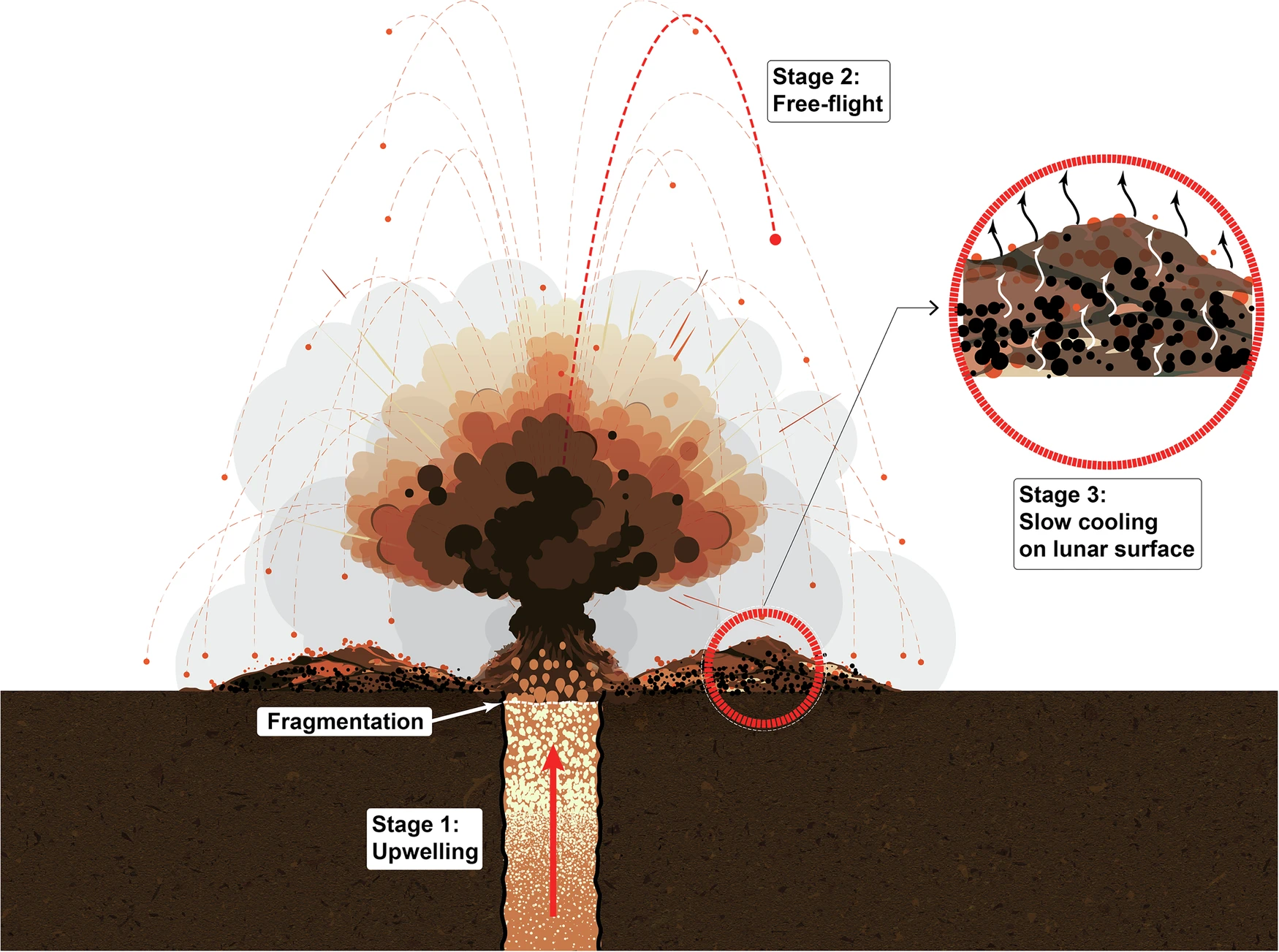
Figure 4. Schematic illustration of the three-stage degassing model for Apollo 17 fire-fountain eruption products. In Stage 1, magma rises through the conduit and releases volatiles as pressure decreases; this early degassing history is recorded by olivine-hosted melt inclusions. In Stage 2, the magma fragments into droplets that are carried upward by expanding gas and then fall back to the lunar surface, forming glass beads. In Stage 3, the erupted beads and surrounding particles accumulate into a deposit that cools slowly on the lunar surface and continues to lose volatiles after the eruption. The figure is from Ni and Zhan (2026).
Rethinking Lunar Stratigraphy and Volatile Cycling
This three-stage model also helps explain several puzzling observations from Apollo 17 core samples.
In the double drive tube collected near the orange-soil trench, the upper layers are rich in bright orange glass beads, while deeper layers are dominated by darker, devitrified black beads. Our model offers an elegant explanation: beads buried more deeply would have cooled more slowly, allowing crystals such as olivine and ilmenite to grow inside the glass. Over time, that devitrification would darken the beads.
The same logic applies to volatile loss. Beads buried at greater depth would remain hot for a longer time and continue degassing over the period. Independent sulfur measurements are consistent with this idea, showing lower sulfur concentrations in deeper samples than in shallower ones.
Our model may also help explain the puzzling "ingassing" signatures reported in some orange beads. Earlier work found U-shaped concentration profiles for sulfur and some metals and alkalis, including copper, sodium, and potassium, suggesting that material moved from the bead surface inward. In our interpretation, this may have happened after eruption, when gases released from deeper, hotter parts of the deposit migrated upward and condensed onto cooler beads closer to the surface. Those shallow beads may therefore have shifted from a degassing regime to an ingassing regime during late-stage cooling.
Conclusion: A More Active Lunar Surface
Our results suggest that lunar pyroclastic deposits did not become chemically inactive as soon as the eruption ended. Instead, they may have remained warm, slowly cooling, and actively releasing volatiles for years on the lunar surface.
That changes how we think about explosive volcanism on the Moon. Rather than producing only brief bursts of gas, lunar fire-fountain eruptions may have created longer-lived local sources of volatiles. In turn, those gases may have contributed to transient local atmospheres and perhaps to the redistribution of water and other volatile species across the lunar surface.
Understanding how volcanic deposits cooled and degassed helps us reconstruct not only the Moon's eruptive history, but also the longer-term cycling of volatiles on the Moon. That matters for planetary science and for future exploration, because it may offer clues to where ancient lunar water ultimately ended up, including whether some of it migrated into permanently shadowed cold traps near the poles.
This broader question is especially relevant as new missions begin to investigate those polar reservoirs directly. China's Chang'e-7 mission, scheduled for launch in the second half of 2026, is designed to explore the lunar south pole and search for water ice and other volatiles in and around permanently shadowed regions. By helping explain how volcanic gases may have been released, transported, and ultimately trapped on the Moon, studies like ours provide important context for interpreting what such missions may find (Figure 5).
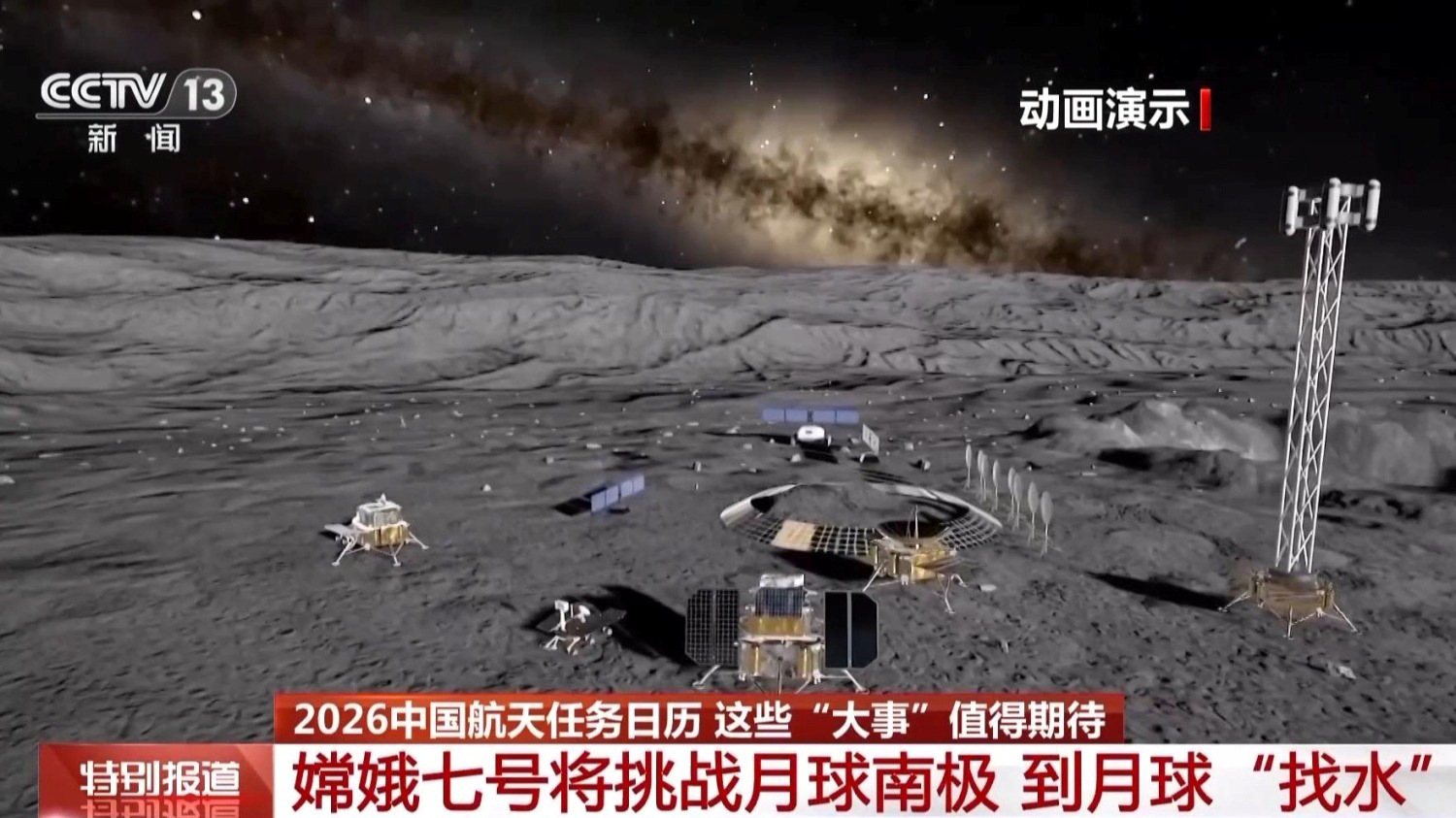
Figure 5. Screenshot from a CCTV-13 news report showing an animated illustration of China's Chang'e-7 mission searching for water at the lunar south pole. Chang'e-7 is intended to investigate the south polar region, including permanently shadowed areas that may preserve water ice.
Original publication
Ni, P., Zhan, Y. Prolonged cooling and degassing of Apollo 17 volcanic glasses on the lunar surface. Nature Communications 17, 2291 (2026). https://doi.org/10.1038/s41467-026-69087-8
Author
Prof Zhan Yan, Assistant Professor, Department of Earth and Environmental Sciences, The Chinese University of Hong Kong
June 2026