
TeV Solar Gamma Ray Research to Reveal the Sun's Hidden Magnetic Fields
A research team led by Professor Kenny Ng Chun-yu from the Department of Physics at The Chinese University of Hong Kong (CUHK), in collaboration with Professor Andrew Hillier from the University of Exeter and Professor Shin'ichiro Ando from the University of Amsterdam, has published a new study, TeV Solar Gamma Rays as a Probe for the Solar Internetwork Magnetic Fields, which introduces a new way to explore the Sun's hidden magnetic fields using high-energy gamma rays. The research proposes an innovative method for exploring the Sun's hidden magnetic fields using high-energy gamma rays, showing that teraelectronvolt (TeV) gamma rays could help unlock the mysteries of magnetic fields hidden beneath the solar surface. The findings have been published in the renowned international journal Physical Review Letters recently.
Exploring solar gamma ray, magnetic fields and cosmic raysTraditional methods for studying the Sun rely on visible light, X-ray or lower-energy emissions to observe its magnetic activity. Solar gamma rays are produced when cosmic rays interact with the Sun's atmosphere, while cosmic rays are extremely energetic particles, produced after the death of stars in the galaxy. Recently, the High Altitude Water Cherenkov Observatory (HAWC) in Mexico detected TeV gamma rays, the most energetic emissions ever recorded from the Sun. This result implies that there must be strong magnetic fields in the Sun to redirect the cosmic rays. However, it is not clear where these fields exist in the Sun, and how cosmic rays navigate the Sun's complex atmospheric magnetic fields and produce these TeV gamma rays are also unclear.
This latest research proposes that strong, horizontal magnetic fields just below the Sun's surface (the photosphere), hidden from direct observation, could be responsible. These fields, known as internetwork fields when they emerge, can redirect high-energy cosmic rays, leading to the production of the TeV gamma rays observed by HAWC. This discovery not only offers a solution to the solar gamma-ray puzzle but also establishes gamma rays as a powerful tool for studying the Sun's magnetic fields, complementing traditional methods.
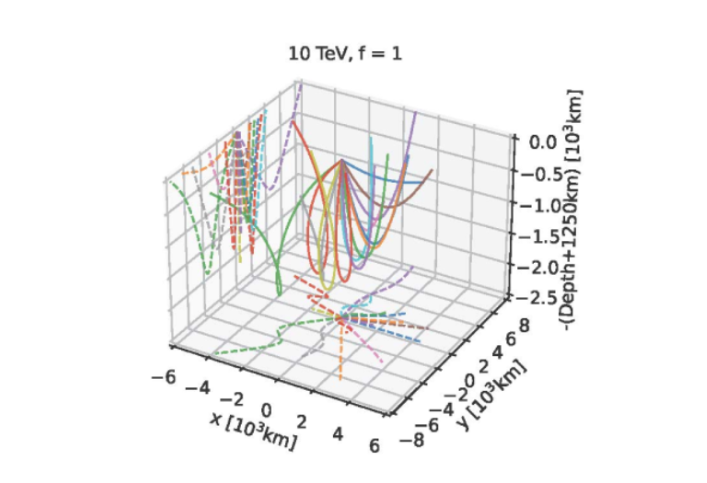
Figure 1. Cosmic rays enter from the top and are then reflected by horizontal magnetic fields.
Solar magnetic fields drive the solar cycle and influence events like solar flares and coronal mass ejections. These phenomena can disrupt Earth's space environment, affecting satellite communications, power grids and space missions. Understanding these magnetic fields is key to improving space weather forecasts, protecting technology and ensuring the safety of future lunar and deep-space missions.
With advanced gamma-ray observations from facilities like the Large High Altitude Air Shower Observatory (LHAASO) in China and future space missions, combined with detailed numerical studies, scientists are closer to unravelling the mysteries of the Sun.
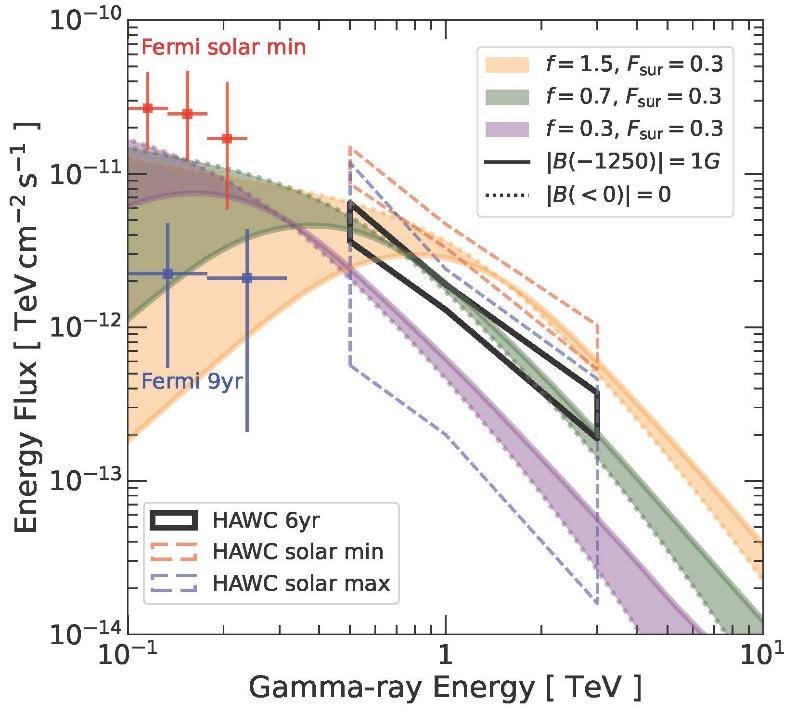
Figure 2. The horizontal internetwork field model could offer an explanation to the TeV solar gamma rays observed by HAWC.
This research is supported by the Croucher Foundation; Research Grants Council (RGC); National Natural Science Foundation of China (NSFC); Science and Technology Facilities Council (STFC) in the United Kingdom; Japan Society for the Promotion of Science (JSPS); a KAKENHI grant from Japan's Ministry of Education, Culture, Sports, Science and Technology (MEXT); and the CUHK Strategic Partnership Award for Research Collaboration (SPARC).
Original publicationNg, K.C.Y., Hillier A., & Ando S. (2025). TeV Solar Gamma Rays as a Probe for the Solar Internetwork Magnetic Fields. Physical Review Letters, 125. https://doi.org/10.1103/l6qw-8c1h.
Dec 2025