

































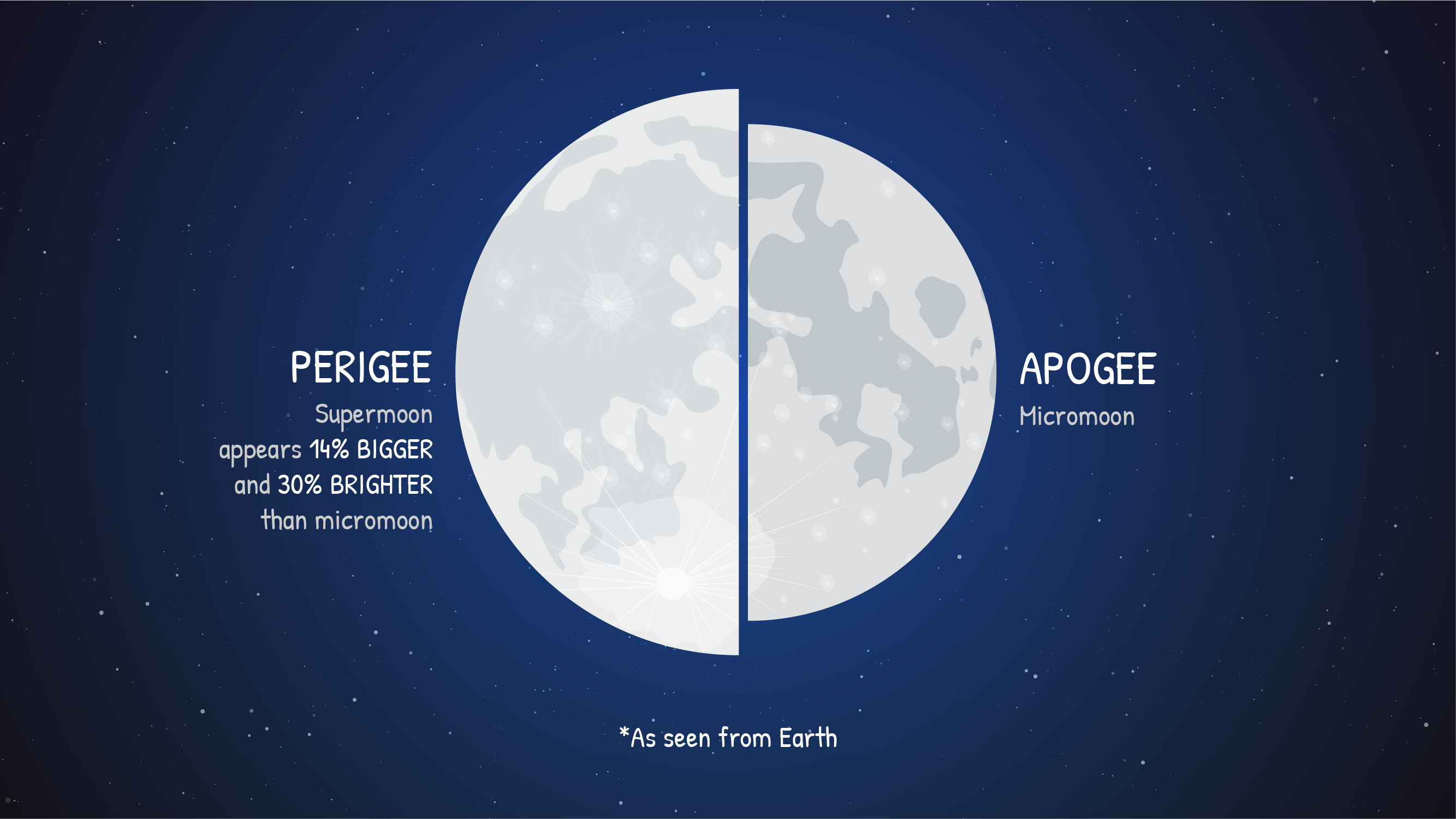
Every year, there are many astronomical phenomena of different scale. The last supermoon in 2020 happened on 7 May. A supermoon occurs when the Moon comes to the closest point to the Earth at the time of a full moon. The Moon will appear as much as 30 percent brighter and about 14 percent larger than usual. Although the supermoon in May caught the eyes of many astrophotographers, it was not the closest full supermoon. On 14 November 2016, the closest full supermoon since 1948 occurred and it will not be surpassed until 25 November 2034. There will be two supermoon phenomena on 26-27 April and 26 May 2021. Let’s see how big the moon will be on these dates.
In June 2020, there are at least two phenomena that will catch the attention of the astrophotographers in Hong Kong. A penumbral lunar eclipse will occur on 5-6 June and then another one on 4-5 July 2020. However, only the one on 6 June will be visible in Hong Kong. Penumbral lunar eclipse occurs more often compared to total and partial lunar eclipse. You may find out more on the formation of penumbral lunar eclipse here.
An annular solar eclipse will also be visible on 21 June 2020 in South/East Europe, North Australia, much of Asia and Africa, the Pacific Ocean as well as the Indian Ocean. However, people in Hong Kong can only see a partial eclipse. The same also happened on 26 December 2019. Find out more about the cause of solar eclipse and the proper way to observe this phenomenon here.
A solar eclipse never comes alone! It always occurs about two weeks before or after a lunar eclipse. Usually, there are two eclipses in a row, one solar and one lunar, but there may occasionally be three, lunar, solar, then another lunar eclipse or solar, lunar, then another solar eclipse during the same eclipse season.
Don’t miss the chance to observe these astronomical phenomena!
Acknowledgement:
Ho Koon Nature Education cum Astronomical Centre (Sponsored by Sik Sik Yuen)
Photo credit:
Jet Propulsion Laboratory - California Institute of technology